
 EUR
 Mexico · MXN
 United States · USD
How long does coenzyme Q10 take to work: the real half-life

You've been taking coenzyme Q10 for four days now, and you're wondering whether you're noticing something or just imagining it. It's one of the most common questions about this supplement, and the answer isn't in your perception: it's in how this molecule moves through your body. Understanding its journey — how long it takes to reach the bloodstream, how long to settle into a steady level, how long to reach the tissues where it actually does its work — is what separates reasonable expectations from giving up too soon, right before the process has had a chance to complete itself.
⏱️ Cellular energy & Routine · 6 min read · Educational information
The first stretch: from capsule to bloodstream
When you take a coenzyme Q10 capsule, the molecule doesn't appear in your blood straight away. Being a fat-soluble substance with a large molecular size, its absorption is slow. The peak blood concentration after a dose is reached at around 6 hours — not 20 minutes, as is the case with smaller, water-soluble nutrients.
From that point on, coenzyme Q10 begins to clear from the blood following what pharmacology calls its half-life: the time it takes for its concentration to drop by half. For Q10, that half-life is roughly 33 hours — over a full day. That's a long time compared with many nutrients, and it has a direct practical implication.
💡 In simple terms
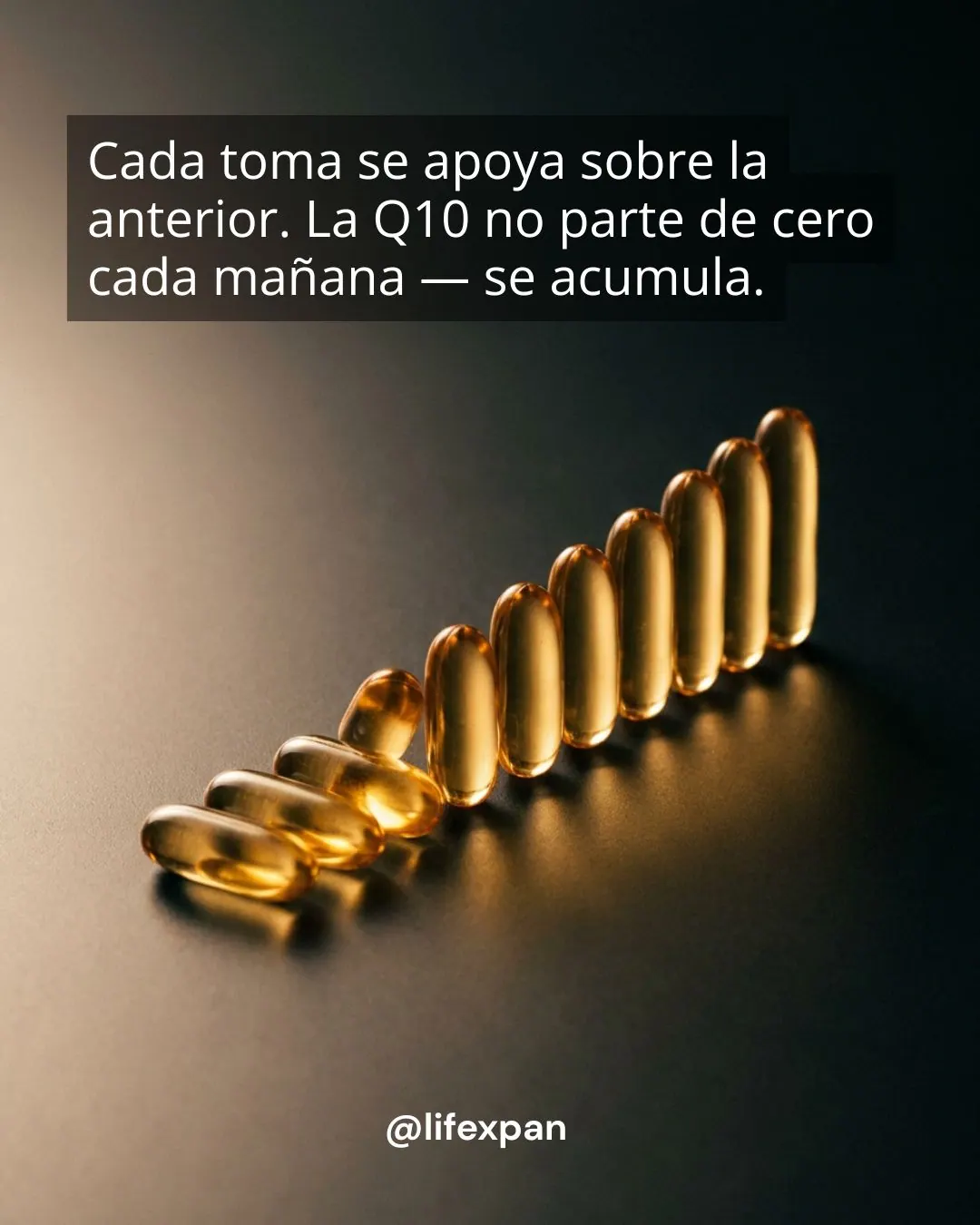
A half-life of 33 hours means that, by the time you take the next day's capsule, a meaningful amount of the previous day's dose is still in your body. You don't start from zero each morning: every dose builds on the last. That's why Q10 doesn't work like an aspirin that acts and then disappears, but rather as something that builds up gradually with consistent use.
The second stretch: reaching steady state
Here's the detail that really changes expectations. Once you start taking a daily supplement, your blood levels don't settle after the first dose: they rise gradually, dose after dose, until reaching what's known as steady state — the point at which the amount entering each day balances out with the amount being cleared. For coenzyme Q10, reaching that balance in the blood takes between one and two weeks of daily use.
In other words: the first few days don't reflect what the supplement can actually offer. They reflect the build-up phase, before levels settle. Judging Q10's effect after three or four days is, in pharmacological terms, judging something that hasn't yet had time to establish itself.
The third stretch, the one that really matters: the tissues
Here's a nuance that's almost never explained, and it's the most important of the three. The fact that coenzyme Q10 reaches steady state in the blood doesn't mean it has already reached sufficient levels in the tissues where it actually does its work — the heart, the muscles, the mitochondria in every cell. Blood is the transport route; tissue is the destination.
Studies that have measured this process directly work with longer timeframes than the two weeks it takes to reach blood equilibrium. One study in patients about to undergo heart surgery found significant increases in coenzyme Q10 in heart tissue after four weeks of daily supplementation. Another study, focused on heart tissue in older adults, used a minimum period of one week before observing changes — but the general pattern in the literature is that full tissue saturation takes anywhere from several weeks to a couple of months, depending on the tissue and the dose.
🔬 Key fact
There are three different clocks running at once: a fast one (hours, to reach the bloodstream), a medium one (one to two weeks, for blood equilibrium) and a slow one (several weeks, to saturate the tissues). Realistic expectations should be based on the slowest of the three, not the fastest.
What this means for your routine
With these three stretches clear, three practical points that often cause confusion make much more sense.
Why you shouldn't judge results in the first week. Neither the blood nor the tissues have reached their equilibrium point yet. Any assessment made in that timeframe is based on a process that's only half finished.
Why daily intake matters more than a one-off dose. Because it has a long half-life, Q10 benefits from regularity. Skipping several days in a row causes the accumulated level to start dropping before you've even reached the stage where tissues fully benefit.
Why one month is a reasonable timeframe for assessment. This isn't an arbitrary figure: it's roughly the time that the literature associates with measurable changes at tissue level. Before that point, the body is still in the process of building up.
✨ The key idea
Coenzyme Q10 isn't a molecule with an immediate effect, and it shouldn't be judged as if it were. It's something that builds up with consistency. The right question isn't "can I feel it yet?" after three days, but "have I taken it regularly for at least a few weeks?".
Why initial absorption matters too
Everything above assumes that coenzyme Q10 is absorbed well from the very first step. But there's another variable that adds to the time involved: the conventional form of CoQ10 is fat-soluble and has limited absorption, so a significant portion of each dose never even starts this journey. The smaller the fraction absorbed, the slower and more incomplete the whole build-up process we've just described becomes.
That's why starting bioavailability isn't a minor technical detail: it determines how much real "raw material" enters this three-stage clock. A form with better absorption doesn't speed up the molecule's half-life — that's fixed physiology — but it does ensure that the amount entering the system is greater from day one, which translates into higher levels at each of the three stages.
⚠️ An important note
These timeframes are indicative and come from studies with different designs and populations; they are not a promise of results. Individual response varies. If you take medication — especially blood thinners or blood pressure treatment — or have a medical condition, consult your healthcare professional before supplementing.
How CavaQ10® fits into this logic
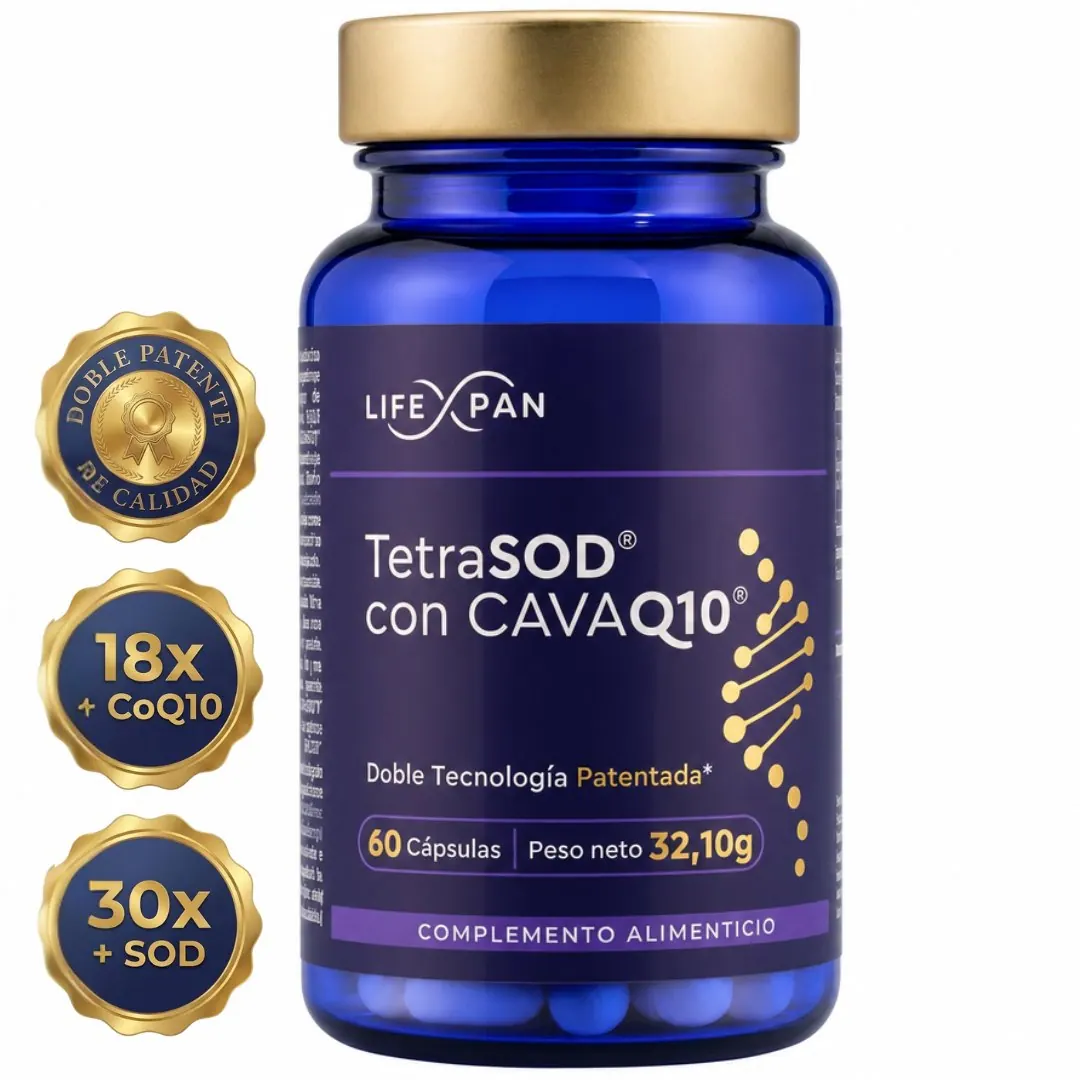
At LifeXpan we designed CavaQ10® with exactly this process in mind. As the first water-soluble coenzyme Q10 — thanks to gamma-cyclodextrin technology — it doesn't depend on dietary fat to be absorbed and reaches up to around 18 times the bioavailability of conventional CoQ10. This doesn't change the molecule's half-life, but it does ensure that, from the very first dose, a greater and more consistent amount enters the system — which helps all three stages of the process complete more effectively over weeks of regular intake.
Take it on an empty stomach, with a glass of water, alongside NR Puro in the morning — a simple habit that, kept up over time, is exactly what this build-up process needs.
Conclusion
Coenzyme Q10 doesn't fail when you don't notice it after three days: it simply hasn't had time to complete its journey. Understanding the three stages — absorption, blood equilibrium and tissue saturation — changes the question from "why isn't it working?" to "have I given it the time and consistency it needs?". And that is, almost always, the right question to ask about any supplement designed to support long-term biological processes.
⚡ CavaQ10® + TetraSOD® by LifeXpan®
The first water-soluble coenzyme Q10: up to ~18× more bioavailable from the very first dose, taken on an empty stomach, with TetraSOD® for cellular antioxidant defence. Designed for the daily, consistent intake this process requires.
Scientific references
Bhagavan, H.N. & Chopra, R.K. (2006). Coenzyme Q10: absorption, tissue uptake, metabolism and pharmacokinetics. Free Radical Research, 40(5), 445–453.
Pravst, I. et al. (2010). Coenzyme Q10 contents in foods and fortification strategies. Critical Reviews in Food Science and Nutrition, 50(4), 269–280.
Rosenfeldt, F.L. et al. (2002). Coenzyme Q10 protects the aging heart against stress. Biofactors, 18(1-4).
Keith, M. et al. (2008). Increased oxidative stress in patients with congestive heart failure. JPEN, 32(3).
Hernández-Camacho, J.D. et al. (2018). Coenzyme Q10 Supplementation in Aging and Disease. Frontiers in Physiology, 9, 44.
Informational content. This does not constitute an authorised health claim. Food supplements are not a substitute for a varied and balanced diet.
This week's connections
→ Instagram: post "3 signs your mitochondria are asking for help" (same theme as the relaunch, TOFU level). → Newsletter: distribute this blog + the post, teasing the CavaQ10® relaunch without revealing the offer yet. → Product: direct link to CavaQ10® included above.
how long to take coenzyme Q10 consistency with Q10 supplements when to notice CoQ10 results how long Q10 stays in the body how long coenzyme Q10 takes to work coenzyme Q10 half-life