
 EUR
 Mexico · MXN
 United States · USD
Glowing skin for spring: collagen, hyaluronic acid and the science behind rejuvenation

The skin is the body's largest organ and the first to reflect what's happening inside. With the arrival of spring, changes in light and temperature create a unique biological window to renew it from within — not with creams, but with science as our guide.
During winter, the skin quietly accumulates damage: cold reduces peripheral circulation, artificial heating dries out the skin barrier, and reduced sun exposure alters the synthesis of key nutrients. When spring arrives, the body receives signals of renewal, bringing with them a real opportunity to restore the radiance, hydration and elasticity that winter has been eroding.
In this article, we explain what happens to your skin as the seasons change, why skin renewal begins from within, and how four molecules — collagen, magnesium, hyaluronic acid and vitamin C — work in synergy to help your skin arrive at summer in its best possible shape.
✨ Skin & Longevity · 6 min read · Backed by science

The skin you see reflects what you synthesise
Skin has three main layers. The outermost — the epidermis — is what we see. But the quality of what we see largely depends on what happens in the middle layer: the dermis. This is where collagen and elastin fibres, the hyaluronic acid network, and fibroblasts — the cells responsible for building and maintaining that whole structure — are found.
From around the age of 25, collagen production begins to decline by roughly 1% each year. By age 40, this accumulated loss is already visible: skin loses firmness, the first expression lines appear, and deep hydration diminishes. By age 50, intradermal hyaluronic acid levels may have dropped by as much as 50%.
| Age | Collagen loss | Visible effect |
|---|---|---|
| 25 years | Decline begins (~1%/year) | Still imperceptible |
| 35 years | ~10% accumulated | First fine lines |
| 45 years | ~20% accumulated | Visible loss of firmness |
| 55 years | ~30% accumulated | Marked wrinkles, sagging |
The good news is that the dermis has the capacity to regenerate. And when given the right building blocks, it can recover part of that lost structure in a measurable way. This is where smart supplementation makes a real difference.
Hydrolysed collagen: building from the ground up
Collagen is the body's most abundant structural protein. It makes up 70-80% of the dermis and is literally the scaffolding on which skin is built. When taken in hydrolysed form — that is, already broken down into small peptides — it can be absorbed through the gut and reach the dermis directly.
Numerous clinical trials published in journals such as Journal of Cosmetic Dermatology and Skin Pharmacology and Physiology show that daily intake of hydrolysed collagen peptides for 8 to 12 weeks significantly improves skin elasticity, reduces wrinkle depth, and increases dermal density. The mechanism works in two ways: on one hand, the peptides act as building blocks for fibroblasts to produce new collagen. On the other, they act as biological signals that directly stimulate the activity of these cells.
💡 In simple terms
Taking hydrolysed collagen isn't the same as taking just any protein. The specific peptides it contains tell your skin to start building more of its own collagen. It's like sending an activation message from within.

Hyaluronic acid: the deep hydration sponge
If collagen is the scaffolding, hyaluronic acid is the water that keeps it alive and elastic. This molecule has an extraordinary capacity for retaining water: it can hold up to 1,000 times its own weight in water. It's responsible for the volume, firmness and that "plump" look of skin that we associate with youthfulness.
Oral supplementation with low molecular weight hyaluronic acid has been shown in clinical studies to effectively reach the dermis and increase skin hydration levels in a measurable way. A trial published in Nutrition Journal showed significant improvements in skin hydration, elasticity and roughness after 12 weeks of oral supplementation, with results comparable to high-concentration topical treatments.
🔬 Key fact
The key lies in molecular size. Low molecular weight hyaluronic acid can cross the intestinal barrier and be distributed via the bloodstream to the tissues that need it most. High molecular weight hyaluronic acid, on the other hand, only acts on the surface — it's what most topical creams contain.
Vitamin C: the switch for collagen synthesis
Here's one of the most important and well-documented links in molecular dermatology: without vitamin C, collagen cannot be properly synthesised.
Vitamin C acts as a cofactor for the enzymes that stabilise collagen's triple helix — the three-dimensional structure that gives it strength and function. If vitamin C levels are insufficient, fibroblasts cannot complete the process, even with all the peptides available. It's the link that connects the raw material to the result.
But vitamin C also has a second, equally important role: it's one of the most powerful antioxidants that protect skin from damage caused by UV radiation and free radicals. With the increased sun exposure that spring brings, this protective role becomes especially relevant.
💡 In simple terms
Taking collagen without vitamin C is like having bricks without cement. Vitamin C doesn't build the structure — it activates the enzymes that assemble it. Without it, the process isn't completed, no matter how much collagen you've taken.

Magnesium: the mineral no one mentions but that coordinates everything
Magnesium is perhaps the least-known ingredient in this protocol, yet its absence compromises everything. This mineral is involved in over 300 enzymatic reactions in the body, several of which are directly relevant to skin health.
Magnesium regulates protein synthesis in fibroblasts, modulates the skin's inflammatory response and contributes to the integrity of the epidermal barrier — the protective layer that prevents transepidermal water loss. Magnesium deficiency, which is far more common than most people think, results in drier, more reactive and inflamed skin with a reduced capacity to regenerate.
🔬 Key fact
It's estimated that more than 50% of the Western population doesn't meet the recommended daily intake of magnesium. A subclinical deficiency — with no obvious symptoms — can directly affect skin quality without ever being linked back to this mineral.
The synergy: why all four together work better
These four molecules don't act in parallel: they act in a chain.
🏗️ Hydrolysed collagen: Provides the peptides that build the dermal matrix and signal fibroblasts to produce more of their own collagen.
💧 Hyaluronic acid: Plumps and retains water in the dermis. Deep hydration, volume and firmness from within.
⚡ Vitamin C: Activates the enzymes that assemble collagen and protects the skin against sun-induced oxidative damage.
🔩 Magnesium: Coordinates fibroblast enzymatic activity and helps keep the skin barrier intact.
The most important thing to understand is that this synergy isn't a marketing gimmick: it's the biological logic of the process. Taking collagen alone without vitamin C is like having bricks without cement. Taking vitamin C without collagen is having cement without bricks. Hyaluronic acid keeps the environment hydrated so that assembly can take place. And magnesium coordinates all the enzymatic machinery that keeps the whole process running.
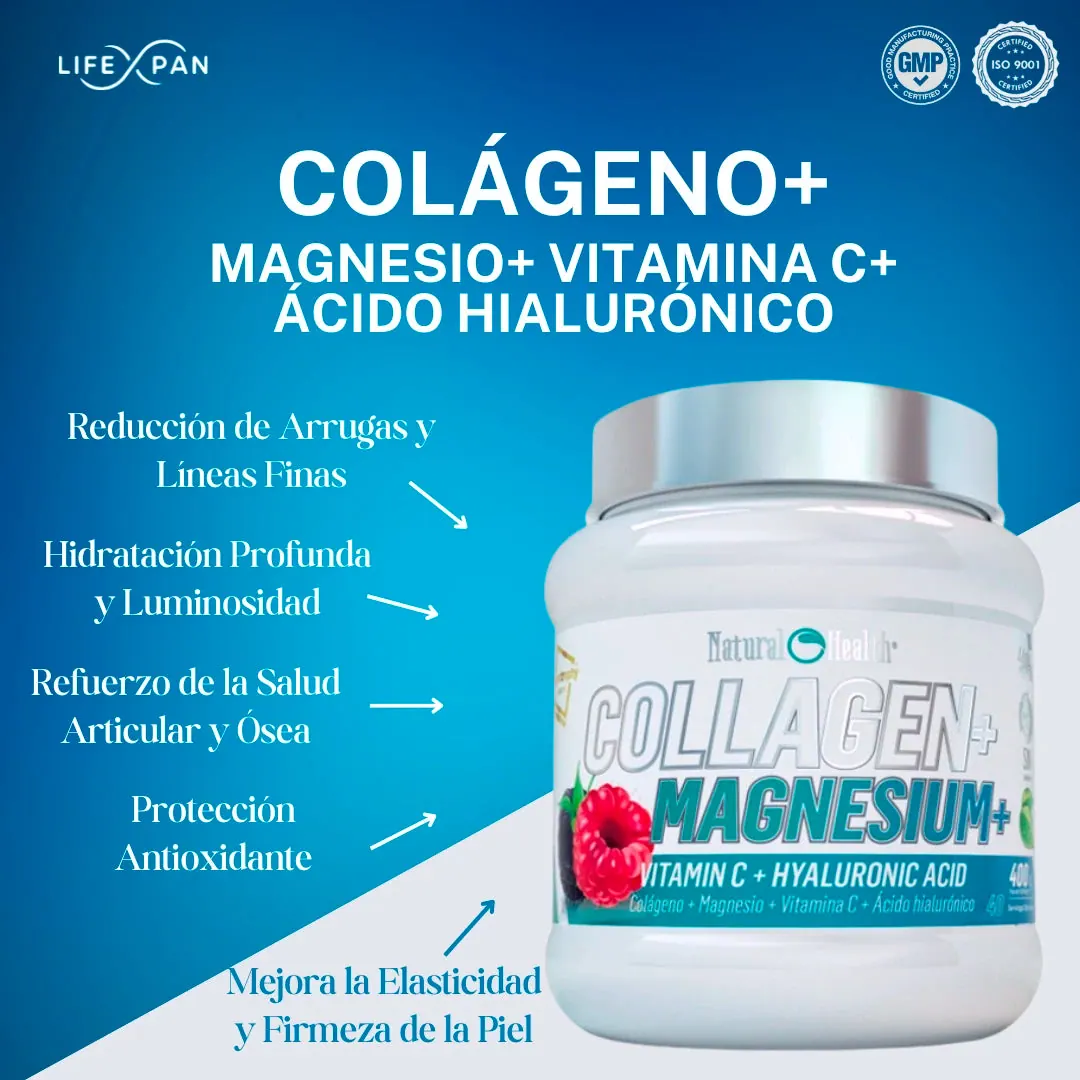
This is precisely the logic behind LifeXpan's formula, designed so that these four molecules work in synergy, with doses that reflect what clinical research has identified as effective.
Spring as a starting point
Spring offers a favourable biological context for this renewal. More sunlight activates vitamin D synthesis, which in turn modulates fibroblast activity. Rising temperatures improve skin microcirculation, helping nutrients reach the dermis. And the circadian rhythm itself, adjusted to longer daylight hours, supports overnight regeneration processes.
Consistency over quantity. Clinical studies consistently show that 8 to 12 weeks of regular intake are needed to see visible, measurable changes. Skin renews itself slowly, and the dermis even more so. Starting in spring means reaching summer — when skin is more exposed and more visible — with a stronger biological foundation.
Hydration from within and from outside. Oral supplementation works in the dermis, where creams can't reach. But combining it with good topical hydration and sun protection enhances the results synergistically.
Reducing oxidative damage. More hours of sunshine in spring is a biological advantage, but it also means greater exposure to UV radiation. Vitamin C and dietary antioxidants — fruit, richly coloured vegetables, extra virgin olive oil — act as a complementary shield.
✨ The key to glowing skin in spring
The radiance we're after doesn't come from a filter or a cream. It comes from a well-hydrated dermis, dense collagen fibres and an intact epidermal barrier. That's not achieved in a week, but it can be built with consistency, the right ingredients and science as your guide.

Conclusion: glowing skin is built from within
The cosmetics industry has spent decades selling the promise of perfect skin from the outside. But molecular dermatology teaches us something different: skin quality depends on what happens in the dermis, and the dermis is nourished from within.
Hydrolysed collagen, hyaluronic acid, vitamin C and magnesium aren't four separate ingredients — they're four links in the same biological process. When taken together, in the right doses and with the necessary consistency, the difference is visible and measurable.
This spring, give your skin what it needs to truly renew itself. Not from the outside. From within.
✨ Here's our LifeXpan® formula
Hydrolysed Collagen + Magnesium Bisglycinate + Hyaluronic Acid + Vitamin C. A synergy formulated for skin hydration, elasticity and radiance.
Scientific references
Proksch, E. et al. (2014). Oral supplementation of specific collagen peptides improves skin characteristics. Skin Pharmacology and Physiology, 27(1), 47–55.
Choi, F.D. et al. (2019). Oral collagen supplementation: A systematic review of dermatological applications. Journal of Drugs in Dermatology, 18(1), 9–16.
Kawada, C. et al. (2014). Ingested hyaluronan moisturizes dry skin. Nutrition Journal, 13, 70.
Pullar, J.M. et al. (2017). The roles of vitamin C in skin health. Nutrients, 9(8), 866.
Denda, M. & Inoue, K. (2018). Magnesium ion modulates skin barrier function. Archives of Dermatological Research.
oral hyaluronic acid benefits oral vs topical hyaluronic acid which is better epidermal barrier beauty from within collagen hyaluronic acid vitamin C together hydrolysed collagen for skin marine collagen peptides how to improve skin from within how to restore skin firmness sun oxidative skin damage dermis fibroblasts skin elasticity collagen deep skin hydration magnesium dry skin nutricosmetics collagen loss with age glowing skin for spring why we lose collagen with age which collagen to take for skin skin rejuvenation skin supplements spring summer skin supplements vitamin C collagen synthesis