
 EUR
 Mexico · MXN
 United States · USD
Urolithin A: the molecule that cleans your mitochondria and slows down ageing

There's a compound that longevity experts have been quietly talking about for years. It's not a drug. It's not a synthetic molecule. Your own gut produces it — if it has the right bacteria to do so. And if it doesn't, you can take it directly.
It's called urolithin A. And in 2022 it starred in one of the most important milestones in longevity science: the first human clinical trial to show that a supplement can activate mitophagy — the process of clearing out damaged mitochondria — and translate it into real, measurable improvements in muscle strength and physical performance. Without changing the exercise routine.
In this article we explain what urolithin A is, exactly how it works, why 60% of the population can't produce it efficiently, and what all this has to do with ageing well — or badly.
⚡ Longevity & Mitochondria · 7 min read · Backed by science
The problem no one's explained to you: your mitochondria are ageing
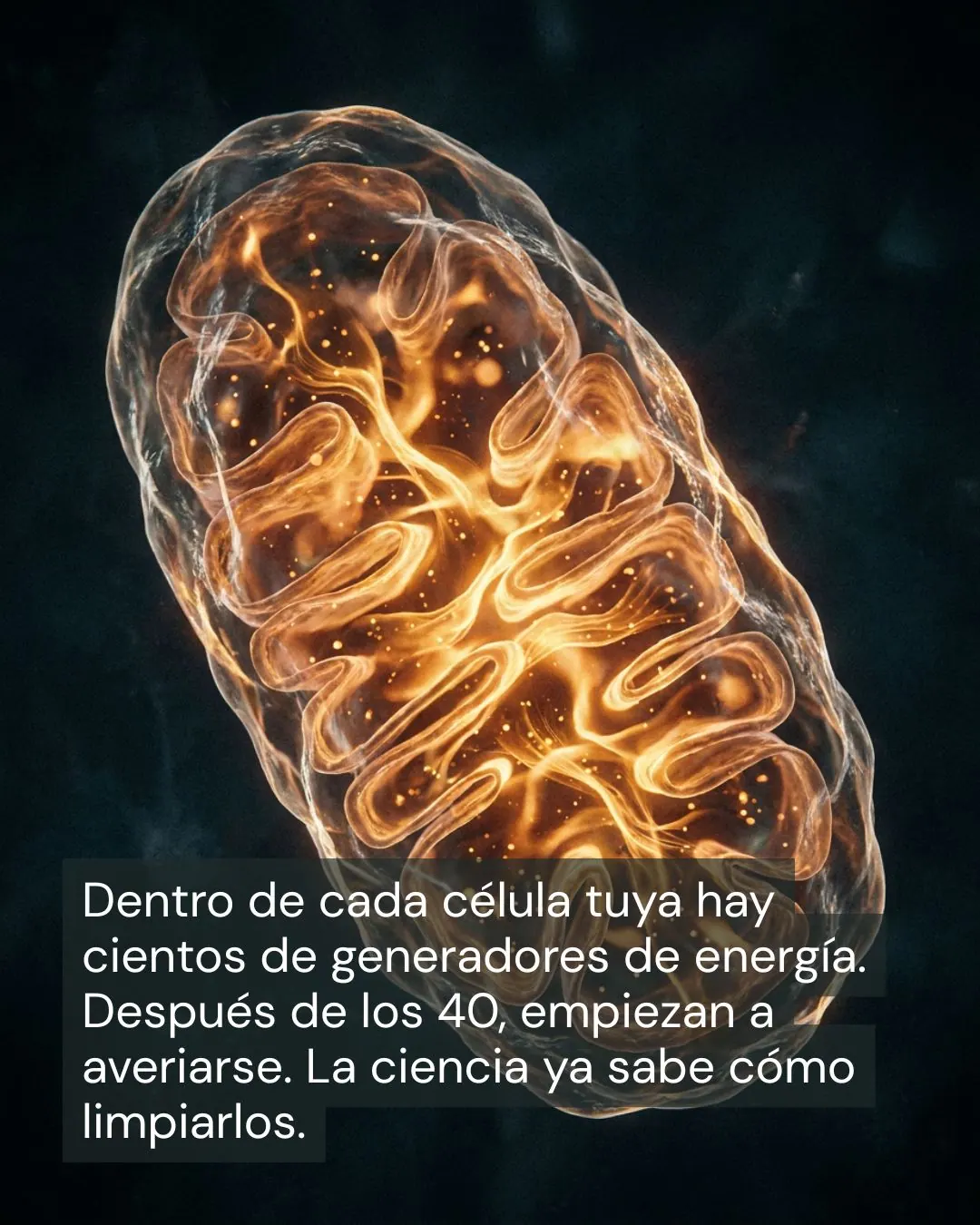
Mitochondria are your cells' power stations. They're the structures responsible for converting the nutrients you eat into ATP — the molecule the body uses to do absolutely everything: move a muscle, think, breathe, repair tissue. Without well-functioning mitochondria, a cell has no energy for anything.
The problem is that mitochondria age. Over time they accumulate damage — mutations in their own DNA, membrane dysfunction, loss of efficiency. And when a damaged mitochondrion isn't cleared away, it doesn't just stop producing energy: it starts generating reactive oxygen species — free radicals that damage the structures around them and trigger chronic inflammatory signals.
It's a well-documented vicious cycle: damaged mitochondria → more oxidative stress → more inflammation → more mitochondrial damage. And it underpins chronic fatigue, muscle mass loss, cognitive decline and accelerated ageing.
🔬 Key fact
From the age of 40, mitochondrial function can decline by up to 50% compared with youthful levels. That drop translates into less energy available to every cell in the body — and it's one of the central mechanisms of biological ageing.
Mitophagy: the recycling system that changes everything
Nature has an elegant solution to the problem of damaged mitochondria: mitophagy. It's a selective autophagy process — the same mechanism that won the Nobel Prize in Medicine in 2016 — applied specifically to mitochondria. The cell identifies mitochondria that are no longer working properly, marks them, breaks them down in a controlled way and recycles them.
The result is a younger, more efficient and less inflammatory mitochondrial population. It's essentially the cell's internal quality control applied to its energy source.
The problem is that mitophagy also slows down with age. And when this clean-up doesn't happen often enough, damaged mitochondria build up. The cell loses energy efficiency. And the body starts to notice the consequences: fatigue, loss of strength, reduced physical stamina, brain fog.
💡 In simple terms
Imagine your cell is a factory with hundreds of electrical generators — the mitochondria. Over time, some generators break down and, instead of producing energy, they start giving off toxic smoke. Mitophagy is the maintenance system that comes in, removes the broken generators and replaces them. When that system fails, the factory fills up with smoke.
What urolithin A is and where it comes from
Urolithin A is a postbiotic — a compound produced by certain gut bacteria when they metabolise ellagitannins, a type of polyphenol found in foods such as pomegranate, walnuts and berries. It's not the polyphenol itself that's active: it's the metabolite the gut produces from it.
Here's the twist that makes it especially relevant: only 30% to 40% of the population has the gut bacteria needed to produce urolithin A efficiently. Everyone else could eat pomegranates daily and still not generate meaningful amounts. Even among producers, the quantity generated varies enormously depending on diet, stress and antibiotic use.
This makes urolithin A one of the strongest arguments in favour of direct supplementation — not as a substitute for a good diet, but as the only way to guarantee the compound reaches the body in amounts with a real biological effect.
The science behind it: from worms to humans
The scientific journey of urolithin A is one of the most rigorous among current longevity supplements. It didn't stop at animal models — it reached clinical trials in people, and the results are significant.
The earliest studies in Caenorhabditis elegans — the worm most widely used in ageing research — showed increases of up to 45% in lifespan with urolithin A supplementation. In mice, the results included improvements in physical endurance and muscle function comparable to the effects of regular exercise.
But the milestone came in 2022, with a clinical trial published in Cell Reports Medicine that marked a turning point: it was the first demonstration in humans that a supplement can activate mitophagy and translate it into concrete physiological benefits. Middle-aged participants who took urolithin A for four months experienced a 12% improvement in muscle strength and a 17% improvement in endurance — without any change to their exercise routine.
| Study | Result |
|---|---|
| Nature Metabolism (2019) | Safety confirmed in humans. Molecular signature of mitochondrial improvement. |
| Cell Reports Medicine (2022) | +12% muscle strength · +17% endurance. First mitophagy demonstrated in humans. |
| EPFL / Johan Auwerx (2022) | Improvements in VO₂max of up to 10% in middle-aged adults. |
| Trials in adults aged 60-90 | Improvements in muscle function, fatigue resistance and autonomous mobility. |
🔬 Key fact
"These results are very promising, as this is the first demonstration in humans that urolithin A repairs mitochondria through mitophagy, and this can translate into concrete physiological benefits." — Johan Auwerx, professor at the Swiss Federal Institute of Technology (EPFL), co-author of the study.
Beyond muscle: what urolithin A does throughout the body
Research into urolithin A goes far beyond muscle function. These are the areas where the evidence is strongest:
Brain health and neuroprotection. Preclinical research suggests that urolithin A may cross the blood-brain barrier and promote mitophagy in neuronal cells, reducing neuroinflammation and the build-up of toxic proteins associated with Alzheimer's and Parkinson's disease. The connection with the gut is no coincidence — the microbiome that produces urolithin A is the same one that protects the gut-brain axis.
Senescent cells and inflammaging. Urolithin A has been shown to reduce the accumulation of senescent cells — the so-called "zombie cells" — by stimulating autophagy and mitophagy. It acts as a senomorphic: modulating the chronic inflammation these cells generate without needing to eliminate them entirely.
Immune system and longevity. Recent studies from 2025 suggest that urolithin A may revitalise blood stem cells, helping to combat the ageing of the immune system — one of the least visible but most decisive processes in biological ageing.
Sarcopenia and physical independence. In adults aged 60 to 90, sustained supplementation with urolithin A has shown improvements in the ability to climb stairs, get up from a chair and walk longer distances. This is no small effect: sarcopenia — the loss of muscle mass with age — is one of the strongest predictors of mortality and loss of independence in old age.
The link with the microbiome: why everything is connected
If you've read our article on the gut microbiome and longevity, here's the missing piece. Urolithin A is the clearest proof that the gut doesn't just digest — it manufactures molecules with systemic effects that no other organ can produce.
The microbiota profile that efficiently produces urolithin A is the same one we find in people with greater bacterial diversity, less inflammaging and a longer healthy life expectancy. This is no coincidence: looking after your microbiome and supplementing with urolithin A are two strategies that reinforce each other.
💡 In simple terms
You could eat all the pomegranate in the world. But if your gut doesn't have the right bacteria to convert it into urolithin A — and 60% of the population doesn't — you won't get the benefit. Direct supplementation guarantees that the compound reaches your body, regardless of the state of your microbiome.

Conclusion: the molecule that biohacking already knows and the wider public is starting to discover
Urolithin A is not a passing trend. It's one of the compounds with the strongest scientific backing in the field of longevity, with a research journey that stretches from worms to human clinical trials — a path very few supplements have completed with such consistent results.
Its mechanism is clear: it activates mitophagy, clears out damaged mitochondria, restores cellular energy efficiency and reduces chronic inflammation. And its effects are tangible: more strength, more stamina, better cognitive function and a younger immune system.
The only obstacle between you and its benefits is your microbiome's ability to produce it. And that obstacle has a solution.
⚡ Support your mitochondrial health with LifeXpan®
While urolithin A acts directly on mitophagy, these two molecules from the LifeXpan® catalogue work on the mitochondria through equally well-documented pathways:
⚡ Pure NR (NAD+): NAD+ is the fuel mitochondria need to produce energy. Without it, neither mitophagy nor mitochondrial biogenesis can happen efficiently. NR supplementation raises NAD+ levels directly and measurably.
🌿 Cursol® Curcumin: Curcumin activates the AMPK pathway — the same route that triggers mitophagy — and reduces the chronic inflammation generated by damaged mitochondria. A natural modulator of the cellular environment in which mitochondria work.
Two molecules. Two different pathways. One shared goal: helping your cells produce energy with the efficiency of someone younger.
longevity biohacking how to activate mitophagy naturally reversible cellular ageing mitochondria and ageing what is mitophagy NAD+ mitochondria energy postbiotic longevity what is urolithin A and what is it for mitochondrial health supplements longevity supplements 2025 urolithin A benefits urolithin A pomegranate supplement urolithin A longevity urolithin A mitophagy